Step 1 of 8
Request
A teacher in cabin A logs in and taps Request delivery to cabin D. The page writes the request to Firebase with status pending. Only A’s own login can do this: the database rules check it.
 NavaYantra
Final-year project · ECE · SJB Institute of Technology · 2026
NavaYantra carries files between staff cabins on request from a phone. It finds its own way on a saved map, and when something goes wrong (it’s picked up, the corridor is blocked, a motor faults, the battery runs low) it gets itself out of trouble.
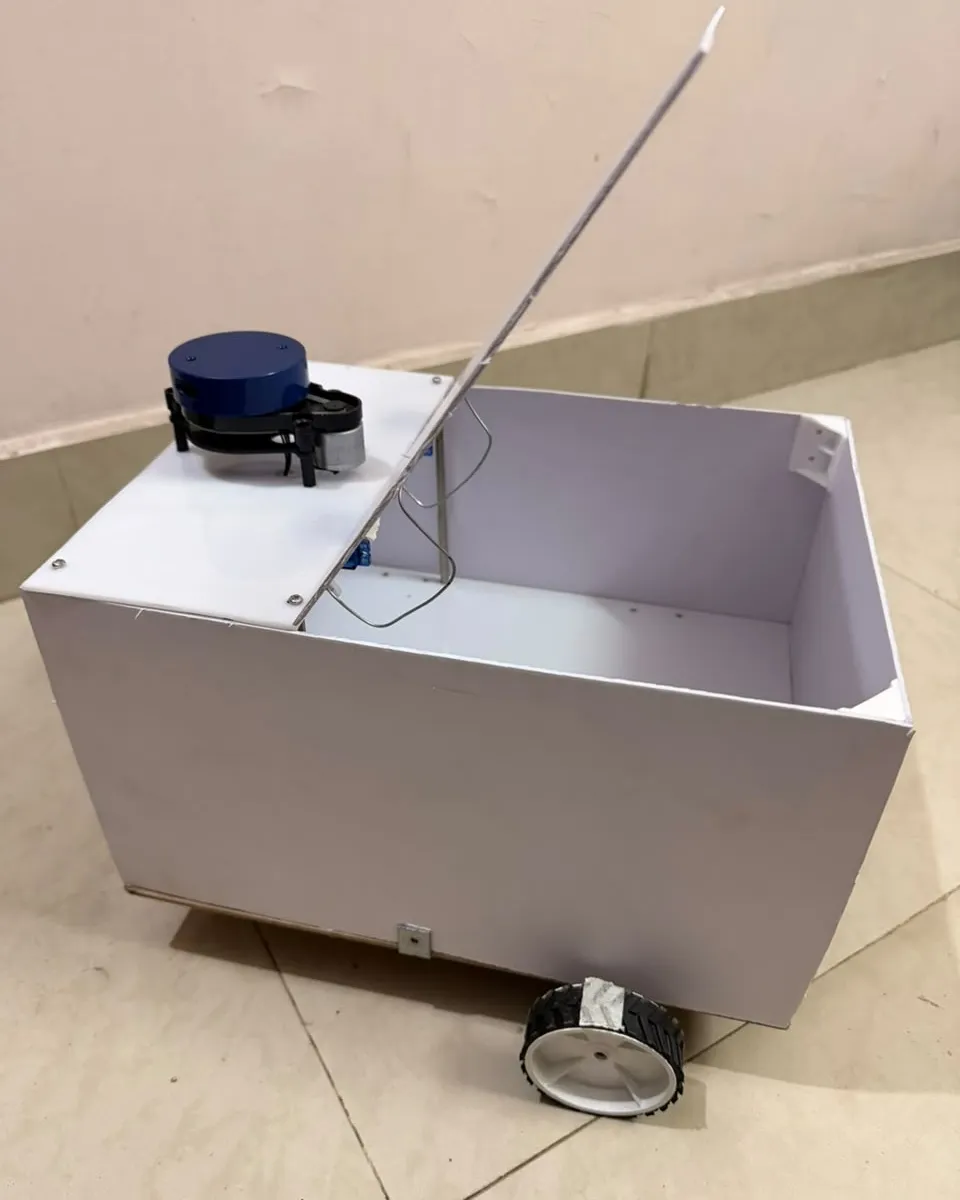 YDLIDAR X2 · 360° scanServo lid, locks while movingFront drive wheels · encoders
deliveries completed in the final home test
times it was picked up and moved, and found itself
median time to recover on its own
driven in the October campaign, 94 of 112 legs reached
robot components, versus lakhs for commercial robots
Rendered in 3D from the real robot dimensions and the three real RViz maps. A 7-minute full explainer and a 30-second vertical cut exist too; the first 3-minute version is kept for comparison.
Four layers, one request. Step through it, or let it play.
Step 1 of 8
A teacher in cabin A logs in and taps Request delivery to cabin D. The page writes the request to Firebase with status pending. Only A’s own login can do this: the database rules check it.
Step 2 of 8
Every 1.5 s the bridge on the laptop reads new requests and hands this one to the delivery manager, which adds it to the queue (urgent and nearest jobs go first).
Step 3 of 8
The manager locks the lid and asks Nav2 for a route. Speed commands go through twist_mux, over Wi-Fi (ROS 2 DDS) to the Pi, then by USB serial to the Arduino and the motors.
Step 4 of 8
Arrival is checked against the map (within 0.5 m). A’s phone beeps three times, the page flashes orange, and it repeats every 15 s until someone responds.
Step 5 of 8
Open lid → put the parcel in → Close lid & send. The Arduino Nano drives the lid servo. The robot does not move until the lid reports locked.
Step 6 of 8
LiDAR scans and wheel odometry flow back from the Pi, so AMCL always knows where the robot is. Its position, ETA and battery appear on both phones about once a second.
Step 7 of 8
D’s phone beeps. The teacher opens the lid, takes the parcel and taps Close lid & done. The request becomes delivered, a final status that is never overwritten.
Step 8 of 8
If another job is queued, the robot goes straight to its sender; otherwise home. The event logger records each leg, which feeds the statistics and the learned ETA.
All 16 steps with the exact Firebase paths, ROS topics and code lines →
Every recovery program can take over the wheels, and twist_mux decides who wins. A higher number beats a lower one.
self_recovery · runs on the laptop · priority 50
If the position jumps or the laser scan stops matching the map (someone picks the robot up, or AMCL drifts), it pauses and matches the scan against the whole map itself, then continues the same leg.
Why it exists. AMCL’s own global localisation took about 90 s and was right only about half the time in tests, so we wrote our own scan matcher.
7 / 7 kidnaps recovered on 12 Nov · median 4.0 s on its own (41 episodes)
path_guard · runs on the laptop · priority 40
Watches the planned path for obstacles and tells people from objects. It waits, goes round, or takes another route. If everything is blocked with a parcel on board it returns it to the sender; before pickup it cancels and goes home.
Why it exists. Our guide asked for four blocked-route cases at the review, and corridors in real buildings are rarely empty.
32 go-rounds, 13 reroutes, 3 detours, 12 fully blocked (Oct campaign)
gap_assist · runs on the laptop · priority 45
The drive wheels are at the front, so the back of the box swings about 0.34 m when turning. When Nav2 gets stuck at a gap, gap assist lines the robot up straight and drives it through.
Why it exists. In the first house test the robot kept turning too early at doorways and Nav2 refused to spin near walls.
70 of 80 manoeuvres succeeded (87.5 %)
safety_watchdog · runs on the Pi
Runs on the Pi, close to the hardware. It catches an Arduino reset, encoder jumps, and wheels turning against the command. It stops the robot, restarts motor control (about 20 s), and the manager resumes the same leg.
Why it exists. A hard stop once reset the motor Arduino and the wheels ran uncontrolled. On 12 Nov the wheels even drove backwards for forward commands. Both are now caught.
7 safety stops, 4 restarted automatically (Oct) · wrong-way rule caught a real repeat on 12 Nov
ultrasonic_guard · runs on the Pi · priority 47
An HC-SR04 sensor at the front, about 15 cm above the floor, sees low obstacles below the LiDAR’s scan plane (about 22 cm up) and stops the robot in time.
Why it exists. A sofa edge was invisible to the LiDAR in a house test.
Overrides Nav2, path guard and gap assist in the priority ladder
battery_monitor + trip prediction · runs on the Pi + laptop
An INA219 sensor measures the pack. Before and during a job the manager predicts the energy needed to finish. It declines the request with an apology, aborts safely before pickup, or finishes on the cheapest option, then goes home to charge.
Why it exists. A robot that dies halfway holds someone’s parcel hostage.
3 / 3 battery trials passed (12 Nov)
Most features exist because a real test failed. Cause → change, in the order it happened.
Odometry over-reported every turn by 31 %.
Measured the wheel separation with a rotation test instead of a guessed value: 0.807 → 1.055.
Motors dead. A new driver and a new Arduino didn’t help.
The common ground wire was missing. “Check ground first” is now step one of the runbook.
AMCL’s global localisation: 90 s, right about half the time.
Our own scan matching across the whole map. A simulated kidnap is now found in 0.6 s.
Review: “what if the corridor is blocked?”
path_guard: wait, go round, reroute, or return the parcel.
Doorways: the back of the box swings 0.34 m.
gap_assist, a body-shaped footprint, and a behaviour tree without spinning.
Arduino resets when stalling against door frames.
Halved acceleration, plus a watchdog that restarts the motors automatically.
Expo morning on a phone hotspot: up to 1.7 s of lag, 0 deliveries.
Afternoon on a wired router: 11 of 14 delivered. The network is part of the robot.
After a reset, the wheels drove backwards for forward commands.
A “wrong way” watchdog rule. It caught a real repeat on job 9 the same day.
From the robot’s own event log (2,698 events), not from memory.
| Test | Result |
|---|---|
| Oct campaign: two houses and the expo (excl. operator cancels) | 25 / 32 delivered (78 %) 95 % interval 61–89 % |
| Expo afternoon on a wired router | 11 / 14 |
| 12 Nov home test | 16 / 16 evaluable jobs delivered |
| Kidnap test (lifted and moved) | 7 / 7 recovered, 5 alone in about 4 s |
| Self-recovery, October (41 episodes) | median 4.0 s, 36 within 5 s |
| Gap assist manoeuvres | 70 / 80 (87.5 %) |
| Battery trials | 3 / 3: decline, abort before pickup, finish cheapest |
| Autonomous exploration | 22.2 m² mapped in 4.2 min |
Lesson from 17 Oct: a missing common ground left the motors dead. The Pi keeps its own power bank so motor noise can't reset it.
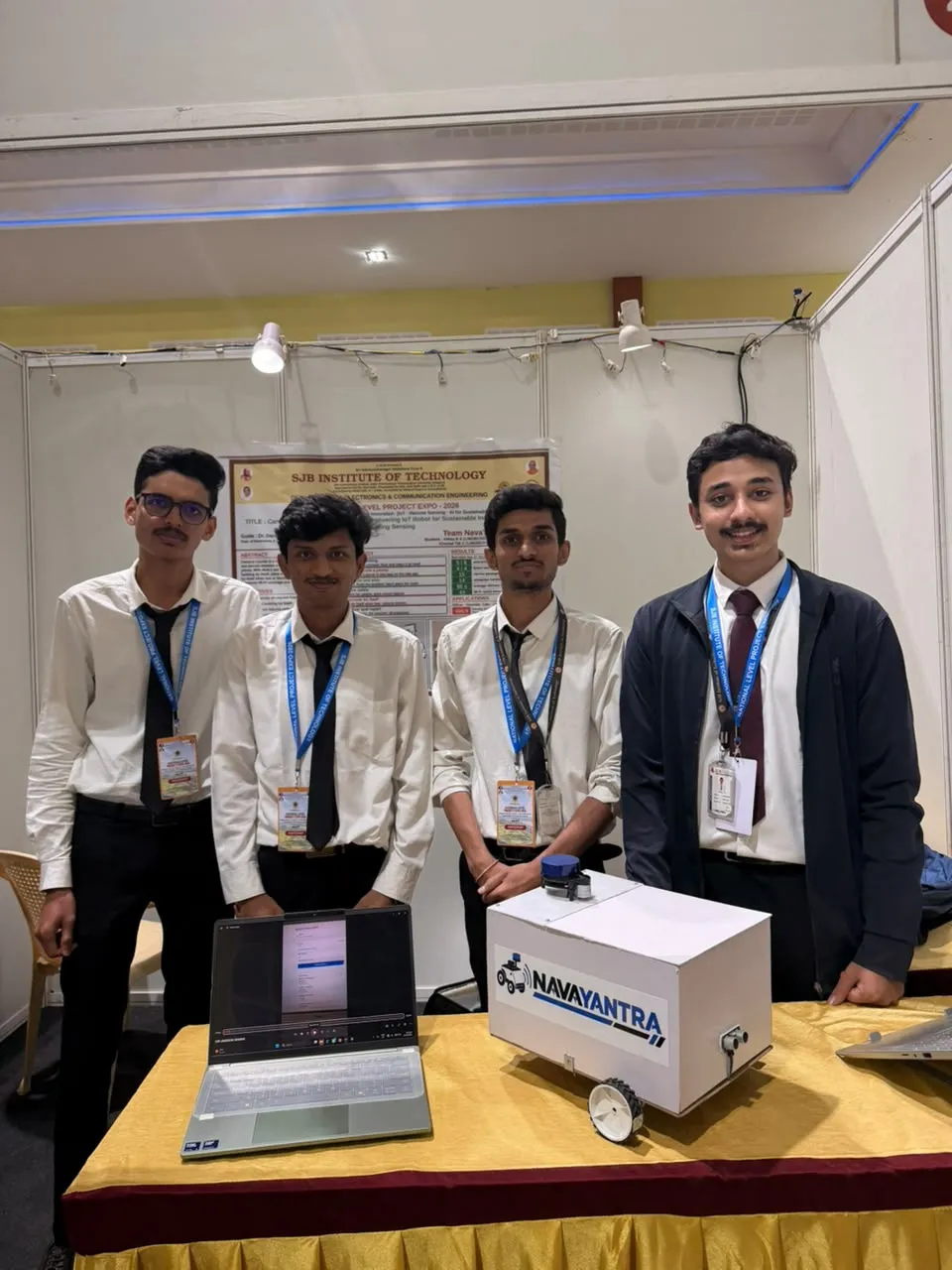
Guide: Dr. Darshan B D
Department of Electronics & Communication Engineering, SJB Institute of Technology, Bengaluru